Tell us about the job
Takes about a minute. No obligation.
A contractor quoting a heat pump repair here has to establish how hard the unit has been running before they can say which components to blame. Homes in Marin County, CA run heat about nine months a year, from October through June. A heat pump working through that kind of extended cold-weather demand leans on its compressor and refrigerant circuit continuously, and both accumulate wear in ways that a mild or short season would not produce at the same rate. When a compressor fails in Marin, the question a contractor asks is whether the unit was sized correctly for this load in the first place, because an undersized system runs longer cycles and stresses its reversing valve and coil sooner than the nameplate predicts.
Ductwork put in for a different system collects debris, develops leaks at joints, and picks up wear at bends and transitions in ways that do not show up on a refrigerant charge or a compressor test. Half the homes in Marin County, California were built in 1967 or earlier (2020-2024 ACS 5-year). A contractor opening up a heat pump here often finds that the unit itself is sound, but that the air pathways feeding it are restricting flow enough to produce fault codes and short cycling that look like equipment failure. Parts for the heat pump are findable; seals on ductwork runs that predate it take more digging to sort.
The Parts of a Heat Pump a Contractor Checks First
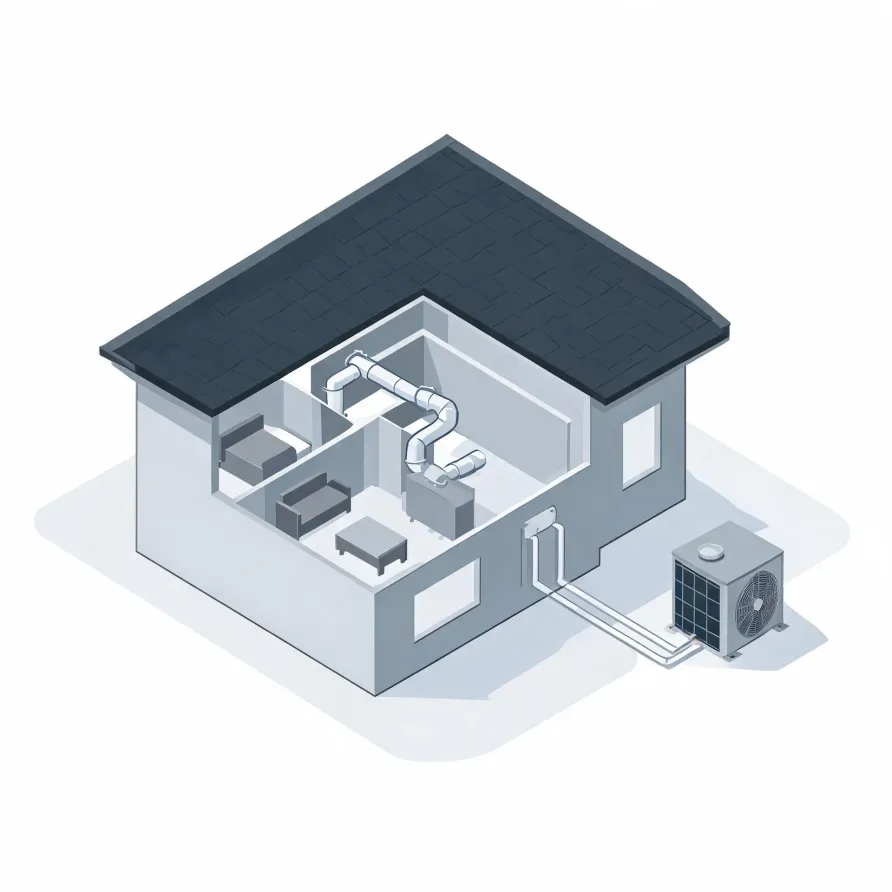
The outdoor unit is the piece most homeowners can point to: it sits on a pad outside the house and holds the compressor and condenser coil. The compressor is where contractors look first when a heat pump stops heating or cooling, because it drives the whole refrigerant circuit. The condenser coil, the fan motor above it, and the refrigerant lines connecting to the house are all failure points a contractor will work through in turn.
Inside the house, the air handler holds the evaporator coil and the blower that pushes conditioned air through the ducts. The reversing valve, which sits in the refrigerant circuit and lets the system shift between heating and cooling, is a common repair target when a heat pump runs but delivers the wrong temperature. The expansion valve and the refrigerant lines that run between the two units round out what a contractor traces when diagnosing a system that is not performing.
The drawing shows a typical heat pump layout, and a licensed contractor will determine which components and conditions apply to your specific home.
Get matched in Marin CountyMarin County, by the numbers
134 severe weather events were recorded in Marin County, California between 2015 and 2024.
NOAA National Centers for Environmental Information, Storm Events Database, bulk CSV export, events 2015-01-01 through 2024-12-31.Half the homes in Marin County, California were built in 1967 or earlier (2020-2024 ACS 5-year).
U.S. Census Bureau, 2020-2024 American Community Survey 5-Year EstimatesMarin County, California holds 112,116 housing units (2020-2024 ACS 5-year).
U.S. Census Bureau, 2020-2024 American Community Survey 5-Year EstimatesOwners occupy 64.7% of the occupied homes in Marin County, California (2020-2024 ACS 5-year).
U.S. Census Bureau, 2020-2024 American Community Survey 5-Year EstimatesCodes & Standards Governing Heat Pump Repair in Marin County, California1 sourced rules and standards
Licensing Rules for HVAC Repair in Marin County, California
California requires a state contractor license: it is a misdemeanour to engage in the business of, or act in the capacity of, a contractor in California without one, unless the work is exempt.
Severe Weather Events in Marin County
Stress on a heat pump comes from the conditions it runs in, and conditions vary by location. The weather record for this area shapes how hard local equipment works and how often repair becomes a real question.
134 severe weather events, 2015–2024. Source: NOAA National Centers for Environmental Information, Storm Events Database.